
01
Manifold blocks
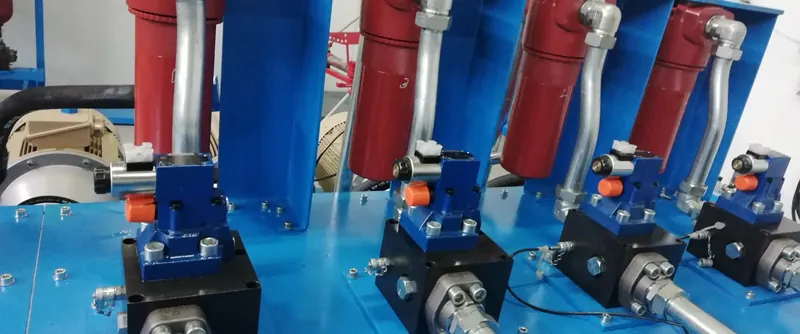
Designed in-house. Cartridge, subplate and proportional valves share one block: fewer pipes, fittings and leak points.
Soydan engineers and manufactures hydraulic power units in İzmir — from compact single-pump OEM units to redundant fleets for steel plants running 24/7. Manifolds, valve stands, electrical panel and PLC/SCADA come from the same floor, and every unit passes a factory acceptance test before it ships.
| Scope item | How we do it |
|---|---|
| Circuit & system design | Hydraulic circuit, component sizing and 3D layout by in-house engineering — from application data sheet or a problem description. |
| Manifold blocks & valve stands | Manifolds designed in-house; valve stands piped, wired and function-tested before shipment. |
| Reservoir & frame fabrication | Tanks and frames welded in-house under EN ISO 3834-2, painted to customer RAL. |
| Electrical panel, PLC & SCADA | Control panels and automation software built with the hydraulics, not after it — one supplier, one interface. |
| Factory acceptance test (FAT) | Every unit runs on the test floor before dispatch — customer witness welcome at the İzmir works. |
| Pickling, flushing & commissioning | Pipework cleaned to the specified ISO 4406 cleanliness class; site installation and start-up by our own field teams. |
Component base: Bosch Rexroth, Parker, Sun Hydraulics, Hydac and the rest of the twelve-brand portfolio — selected per application, never forced to one catalogue.
Everything sits on one frame, connected to the machine by pressure and return lines and a power supply.
| Component | What it does | Source |
|---|---|---|
| Reservoir | Stores the oil; lets it shed air and heat while dirt settles. | In-house, welded under EN ISO 3834-2 |
| Motor-pump group | Gear, vane or axial-piston pump, fixed or variable displacement. | Bosch Rexroth; Settima Meccanica low-noise screw pumps |
| Valves & manifold | Relief, directional, proportional and servo valves in one manifold block: less piping, fewer leak points. | Bosch Rexroth, Parker, CBF Hydraulic; Sun Hydraulics cartridges in manifolds we design and build |
| Filters & cooler | Keep the oil clean and at working temperature; off-line loop on 24/7 units. | Hydac |
| Accumulators | Cover peak flow and allow a safe stop on power failure. | Hydac |
| Instruments & panel | Pressure, level and temperature signals; motor starter, PLC and SCADA link. | Hydac sensors; panel in-house |
Brand pages: Bosch Rexroth · Hydac · Sun Hydraulics · Parker · Settima Meccanica · CBF Hydraulic. Spares for an existing unit? Send us the code via the part-number lookup.
A pump makes flow; the load creates the pressure. So design starts at the actuators: what force, at what speed, how often. These rules give a first sizing only.
The worked example is illustrative, not from a real project. The component maker's cleanliness class is binding.
| Criterion | Catalogue unit | Custom unit |
|---|---|---|
| Starting point | Catalogue tank, motor and pump combination | The machine’s duty cycle and plant specification |
| Typical duty | Simple machines, intermittent use | Presses, lines, process plant; continuous or 24/7 |
| Pump & control | Fixed gear pump, on/off valves | Variable pump, proportional or servo valves, accumulators |
| Cooling & filtration | Often a return filter only; cooler optional | Sized to the heat load and ISO 4406 target |
| Redundancy | None | Standby pump group, duplex filters |
| Records | Catalogue sheet | FAT record, circuit diagram, 3D model, component list |
A catalogue unit often suffices for a few minutes a day on one cylinder. Go custom when cycle time sets output, the unit runs 24/7 or proportional or servo valves are involved. We size every unit to its application.
Duty cycle and environment shape the design.
Sector detail: steel and iron, presses and metalworking. Cylinders come from the group's own İzmir plant — Hydrocyl™ cylinders and press cylinders — so flow, speed and cushioning are sized with the unit.
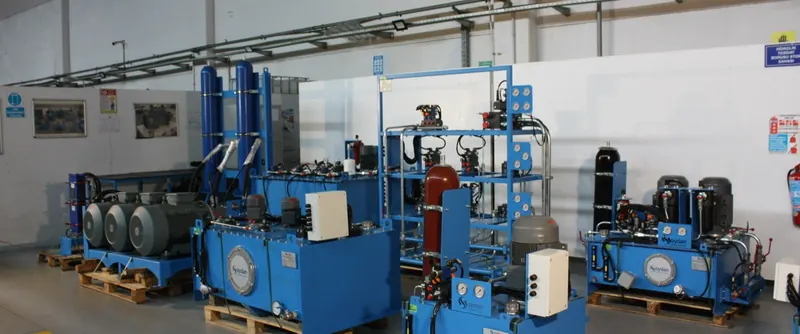
Redundant pump groups, accumulator and filtration stations for a steelworks CCM — FAT-tested together.
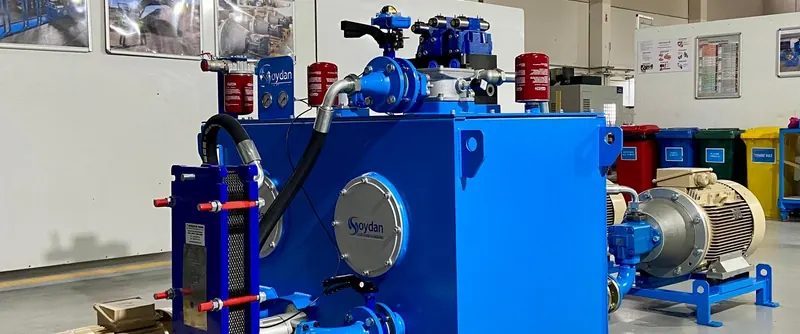
24/7 duty beside the furnace line, plate-cooler thermal management.
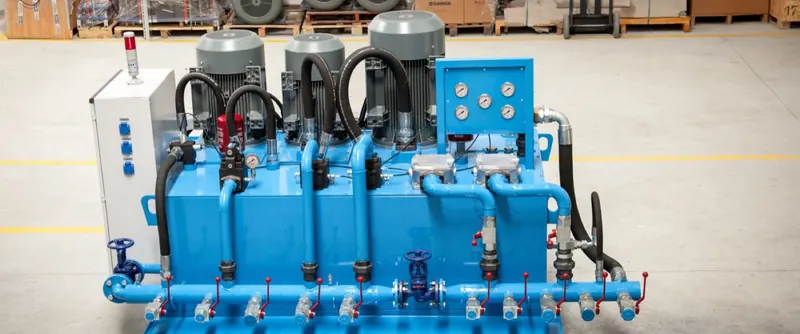
75 kW pump groups and high-capacity filtration for round-the-clock foundry duty.
Pickling & flushing of plant piping to servo-grade cleanliness classes.
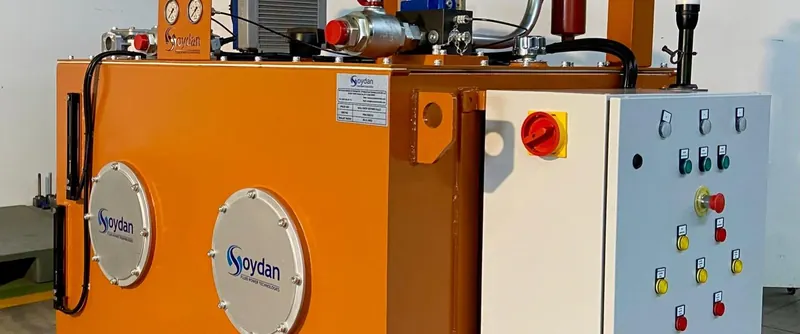
Compact HPU with the electrical cabinet integrated on the frame.
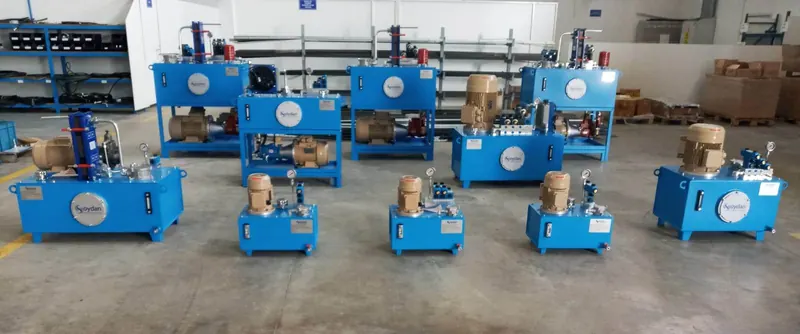
Batch production of identical HPUs, each function-tested before shipment.
Duty cycle, ambient temperature and scope are most often missed — and cause most differences between quotes.
Missing data? Describe the machine and its job; we do the sizing. Send it via Instant Quote or talk to engineering; for cylinders, try the drawing generator.
A hydraulic power unit (HPU), or hydraulic power pack, turns electric motor power into pressurised oil flow for cylinders and hydraulic motors. Reservoir, motor-pump group, valves, filters, cooler and controls sit on one frame.
Yes — control panels, PLC programming and SCADA integration are done in-house, designed together with the hydraulic circuit. One supplier is accountable for the whole system.
Yes — redundant pump groups with accumulator and filtration stations are standard practice for steel-plant and foundry systems that run 24/7; delivered examples include continuous-caster and pusher-furnace units.
Every power unit is run and function-tested at the İzmir works before dispatch. Customer witness testing is welcome, and commissioning on site is done by our own field teams.
Circuit diagram, 3D model and GA drawings, component list, panel schematics and the test record — plus operation & maintenance manuals on request.
P [kW] = p [bar] × Q [l/min] ÷ (600 × η), where η is the overall pump efficiency, about 0.80–0.90. Example: 200 bar, 50 l/min and η = 0.85 give about 19.6 kW; the next standard motor is 22 kW.
Flow, pressure, duty cycle and environment — or just the machine it drives. Both work.
Talk to Engineering → Instant Quote